Yes, Base44 is worth it in 2026 for entrepreneurs, small businesses, and non-technical users who need to build functional applications quickly and affordably. The platform's AI-powered, prompt-based system significantly lowers the barrier to app development, making it an excellent choice for creating prototypes, Minimum Viable Products (MVPs), and internal business tools without writing code.
Base44 is an advanced AI-driven, no-code platform that lets users create web and mobile applications by describing their idea in a text prompt. It translates natural language into functional app components, including user interfaces, databases, and logic, which automates much of the traditional development process and accelerates deployment.
Looking for more AI tools? Explore 500+ ranked options at top10k.com before deciding.
The platform operates on a tiered subscription model with plans catering to diverse needs, from a free tier for exploration to professional and business plans with advanced features. This flexible pricing structure ensures individuals and businesses of various sizes can access the technology, making app development more attainable.
Is Base44 a Worthwhile AI App Builder in 2026?
Yes, Base44 is a worthwhile AI app builder in 2026 for users prioritizing speed, simplicity, and cost-effectiveness over deep customization. Its value is most apparent for non-developers, startups, and small businesses aiming to validate ideas or streamline operations without significant technical investment. To determine if Base44 is the right choice, we will analyze its pros and cons and identify its ideal user profile.
What Are the Main Pros and Cons of Using Base44?
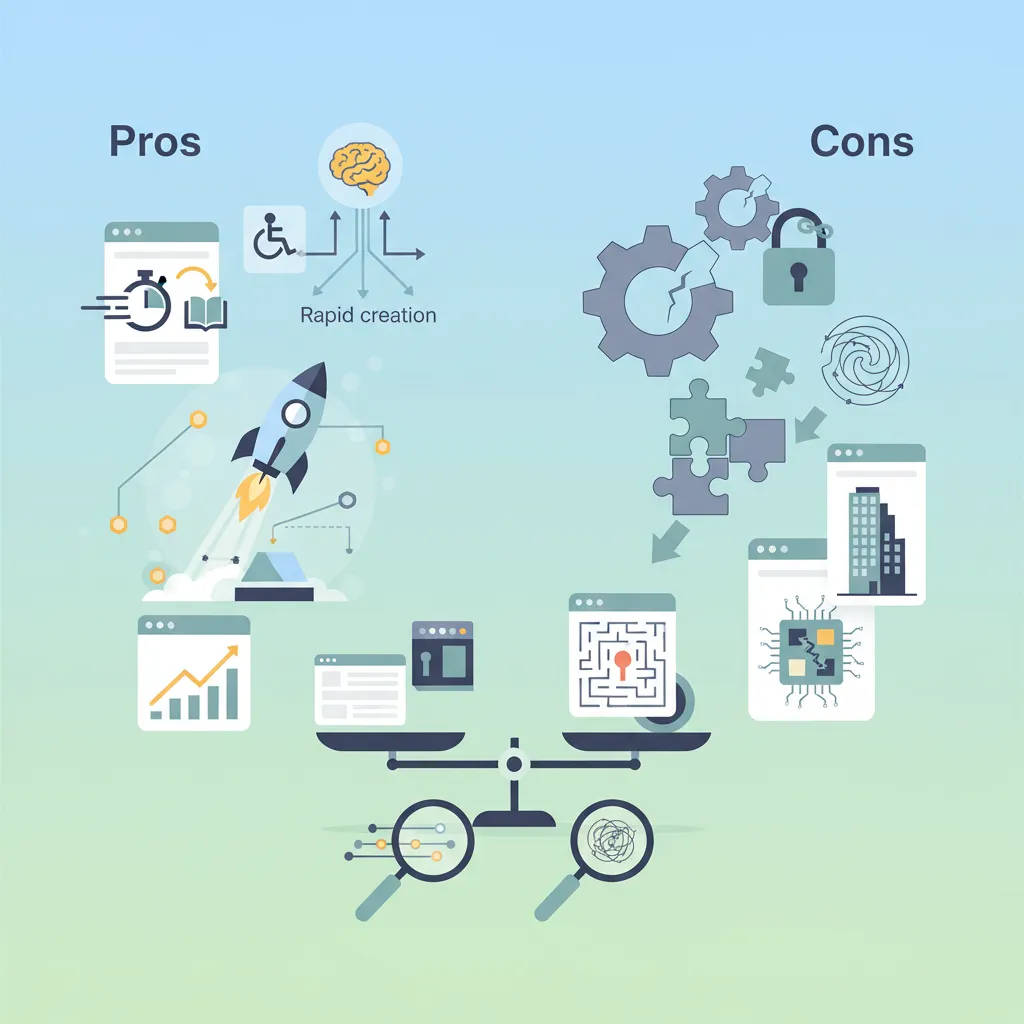
The primary pros of using Base44 are its exceptional development speed, intuitive prompt-based interface, and cost-efficiency. The main cons include limitations in design flexibility, potential constraints on complex logic, and a dependency on the AI's interpretation of user prompts for sophisticated features. Examining these advantages and disadvantages provides a clearer understanding of the platform's capabilities.
Pros of Base44:
- Unmatched Speed: The platform's most significant advantage is its ability to generate a functional app from a text prompt in minutes, which drastically reduces development time. According to Cybernews, this allows for rapid prototyping and market testing.
- Ease of Use: Base44 is designed for users without coding experience, offering a natural language interface that is more accessible than traditional drag-and-drop builders that still require a learning curve.
- Cost-Effectiveness: By eliminating the need to hire developers or learn to code, Base44 significantly lowers the financial barrier to app creation, and its tiered pricing with a free plan makes it accessible to a wide audience.
- Rapid Iteration: Users can quickly modify and regenerate their applications by adjusting their text prompts, making the iteration process fluid and efficient for agile development and refining an MVP based on user feedback.
Cons of Base44:
- Customization Limits: The AI, while powerful, may not offer the granular control over UI/UX design that a traditional developer or a more mature no-code platform provides, making it challenging to achieve a highly specific aesthetic.
- Scalability Concerns: Base44 may not be the optimal solution for applications expected to handle massive user loads or require complex, enterprise-grade backend logic, as it is best suited for MVPs and small to medium-scale applications.
- AI Interpretation Issues: The platform's effectiveness depends on the AI's ability to understand the user's prompt, and vague or overly complex prompts can lead to incorrect results, requiring users to learn how to phrase their requests effectively.
- Platform Dependency: Building on Base44 means you are within a proprietary ecosystem, so migrating an app to another platform or a custom code base would likely require a complete rebuild.
Who Is Base44 Best Suited For?
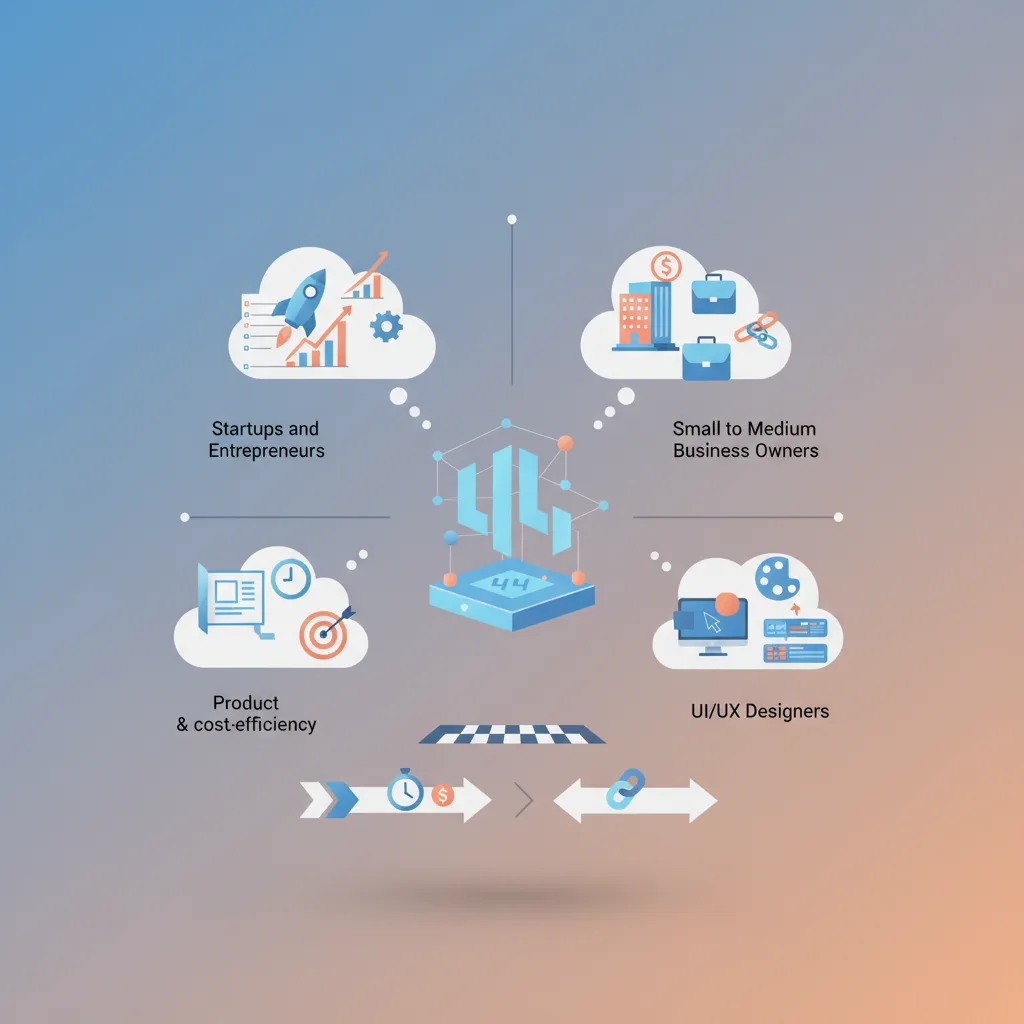
Base44 is best suited for entrepreneurs, small business owners, product managers, and marketing teams who lack technical expertise but need to build applications quickly. This tool is ideal for individuals and organizations focused on creating MVPs, prototypes, internal tools, and simple customer-facing apps. Understanding the specific user profiles that benefit most from Base44 can help clarify its value.
- Entrepreneurs and Startups: Individuals with a new app idea can use Base44 to build a functional prototype or MVP to pitch to investors and gather initial user feedback without a large upfront investment, leveraging its critical speed advantage.
- Small to Medium-Sized Businesses (SMBs): SMBs can use Base44 to create custom internal tools like inventory management systems, customer relationship managers (CRMs), or project tracking dashboards to improve operational efficiency.
- Product Managers and Designers: These professionals can use the platform to quickly build and test interactive prototypes of new features or products, enabling more effective user testing and validation before committing development resources.
- Educators and Students: The platform serves as an excellent educational tool, allowing students to learn about app logic and development principles in a hands-on, code-free environment.
- Marketing Professionals: Marketers can build simple apps for campaigns, such as lead generation forms, event registration portals, or interactive calculators, without relying on the IT department.
What Exactly Is Base44 and How Does It Function?
Base44 is an AI-powered no-code application development platform that transforms text prompts into functional web and mobile applications. It functions by using sophisticated AI models to interpret these prompts, automatically generating the underlying code, designing the user interface, and configuring the necessary database structures. This innovative approach evolves beyond earlier no-code tools by acting as a virtual developer.
How Does Base44 Use AI to Generate an App from a Prompt?
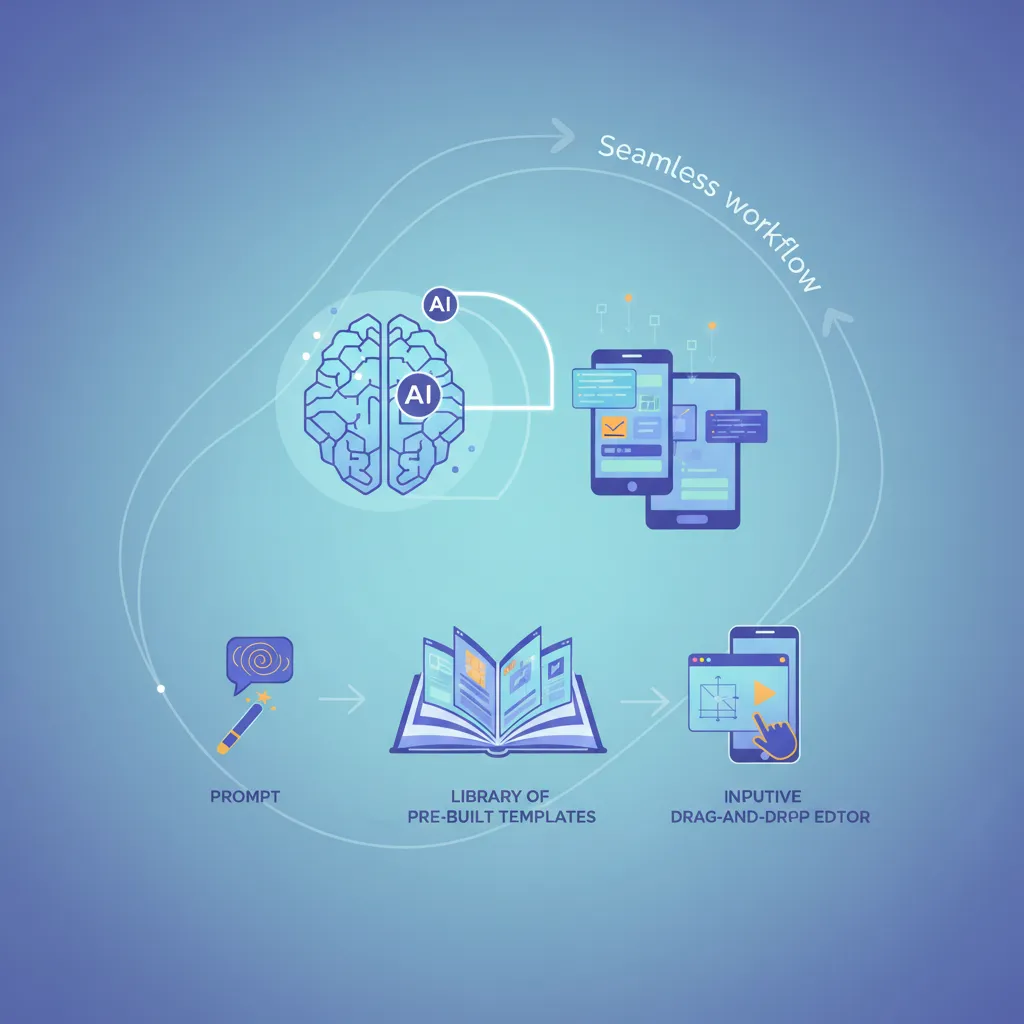
Base44 uses a multi-layered AI system with Large Language Models (LLMs) and specialized code-generation models to translate a text prompt into a functional application. The AI analyzes the user's prompt to understand the app's purpose, features, data requirements, and user flow, then systematically generates the front-end, back-end, and database. This automated process streamlines development significantly.
The AI generation process follows these steps:
- Prompt Analysis and Deconstruction: When a user enters a prompt like, "Create a simple project management app with tasks, deadlines, and user assignments," the AI deconstructs the request into core components: a task entity, date fields, and a user assignment system.
- Database Schema Generation: The AI designs a database schema based on the identified components, creating tables for 'Projects,' 'Tasks,' and 'Users' and establishing the necessary relationships between them.
- User Interface (UI) Creation: The AI generates the visual front-end, creating screens for viewing projects, adding tasks, and assigning users while intelligently selecting appropriate UI elements like forms, lists, and calendars.
- Backend Logic and API Generation: The AI writes the server-side logic and APIs required for the app to function, handling data processing and business rules for actions like creating a task or updating its status.
- Deployment: Base44 compiles and deploys the application, making it accessible via a web link. This entire process can be completed in minutes, a task that would traditionally take days or weeks.
What Are the Key Features Included in the Base44 Platform?
The Base44 platform includes a comprehensive set of features to support the entire application lifecycle, from creation to deployment and management. These features include an AI prompt interface, customization options, third-party integrations, and one-click deployment. Exploring these core functionalities reveals the platform's full potential for app builders.
Comparing alternatives? Discover the full ranked list on https://top10k.com before committing to any single platform.
- AI Prompt-Based Generation: The central feature where users describe their desired app in plain English, allowing the AI to interpret the request and build the application's foundation.
- Visual Editor and Customization: After AI generation, a visual editor allows users to fine-tune the app's appearance, layout, colors, and fonts to match specific branding requirements.
- Database Management: Base44 provides an intuitive interface for managing the app's database, letting users view, add, edit, and delete data records without writing SQL queries.
- User Authentication: The platform offers built-in user authentication, enabling developers to easily add sign-up, login, and user management functionalities to their applications.
- Third-Party Integrations: Base44 supports integrations with popular services like Stripe for payments, Google Maps for location services, and Zapier for connecting with thousands of other apps, extending application functionality.
- Responsive Design: Applications built with Base44 are automatically responsive, ensuring they work seamlessly across desktops, tablets, and mobile devices.
- One-Click Deployment: Users can deploy their applications to the web with a single click, as Base44 handles all the complexities of hosting, security, and infrastructure management.
What Are the Pricing Plans for Base44?
Base44 offers a tiered pricing structure with multiple plans designed for a range of users, from individuals testing an idea to businesses deploying critical applications. The plans include a free tier, a pro tier for individuals and small projects, and a business tier for larger teams and more demanding use cases. The model is designed to scale with your needs, allowing you to start small and upgrade as your application grows.
This table outlines the typical features included in each Base44 subscription tier. Reviewing this breakdown helps potential users select the plan that best aligns with their project scope and budget.
| Feature | Free Plan | Pro Plan | Business Plan |
|---|---|---|---|
| Number of Apps | 1-2 Apps | 5-10 Apps | Unlimited Apps |
| AI Generation Credits | Limited (e.g., 50/month) | Generous (e.g., 500/month) | Unlimited |
| Database Records | Up to 1,000 | Up to 25,000 | Custom/Unlimited |
| Custom Domain | No | Yes | Yes |
| Base44 Branding | Yes | No | No |
| Third-Party Integrations | Basic | Advanced | Premium |
| Team Collaboration | No | 2-3 Users | 10+ Users |
| Support Level | Community Forum | Email Support | Dedicated Support Manager |
This table provides an illustrative breakdown. For the most current and precise details, consult the official Base44 pricing page.
How Does Base44's Pricing Compare to Other No-Code App Builders?
Base44's pricing is competitive with other leading no-code app builders and often provides better value for rapid prototyping and MVP development. While platforms like Bubble or Adalo might offer more granular control, their pricing can scale up more quickly and they often have a steeper learning curve. A direct comparison highlights Base44's unique position in the market.
- Base44 vs. Bubble: Bubble is known for deep customization but can be complex for beginners, and its pricing based on "workload units" can become expensive as an app scales. Base44's simpler, prompt-based approach and predictable pricing are more attractive for initial development.
- Base44 vs. Adalo: Adalo excels at building native-style mobile apps but can be more expensive than Base44's entry-level plans, especially for publishing to multiple app stores. Base44's strength is its generation speed for both web and mobile-responsive apps.
- Base44 vs. Glide: Glide is excellent for creating simple apps from data sources like Google Sheets but can be restrictive for complex, custom applications. Base44's AI offers more flexibility in generating unique app structures beyond templates.
Base44 positions itself as a high-value option for those who need to build and test ideas fast, with its AI-first model providing a unique speed advantage at an accessible price point.
What Are Some Potential Drawbacks of Relying on AI for App Building?
While Base44's AI-driven approach offers significant advantages, potential drawbacks exist that users should consider. These challenges include the risk of generic designs, the learning curve associated with effective prompting, and the limitations when dealing with highly niche or unconventional application logic. Understanding these issues provides a balanced perspective on the platform's suitability for complex projects.
Can the AI Produce Unoriginal or Generic App Designs?
Yes, one potential drawback is that the AI may produce designs that feel unoriginal or generic if prompts are not specific enough. Because the AI is trained on vast datasets of existing application designs, it may default to common layouts and UI patterns, which can make it difficult to create a truly unique and memorable user experience without significant manual refinement in the visual editor.
Is There a Learning Curve to Writing Effective Prompts?
Yes, there is a learning curve to writing effective prompts that accurately translate an idea into a functional app. Users must learn to be specific, clear, and detailed in their descriptions. Vague language can lead the AI to make incorrect assumptions about features, user flows, or database structures, requiring multiple iterations of prompt refinement to achieve the desired outcome.
How Does Base44 Handle Extremely Complex or Niche Logic?
Base44 may struggle with extremely complex or niche business logic that falls outside common application patterns. While it excels at building standard features like user management, data entry forms, and dashboards, implementing highly specialized algorithms, real-time data processing, or unconventional workflows might exceed the AI's current capabilities, potentially requiring custom code or a more powerful no-code platform.
What Are the Alternatives to Base44?
While Base44 is a powerful AI app builder, several strong alternatives exist in the no-code market, each with unique strengths. The best alternative depends on your specific needs, such as the type of app you want to build, your technical comfort level, and your budget. Exploring these alternatives provides a broader perspective on the no-code landscape and helps determine where Base44 fits.
How Does Base44 Differ from Traditional No-Code Platforms?
Base44 differs from traditional no-code platforms primarily through its AI-first, prompt-based generation method. Traditional platforms like Bubble or Webflow provide a visual, drag-and-drop canvas where users manually build interfaces and logic, whereas Base44 automates this initial creation process based on a natural language description, functioning more like a conversational developer.
What Are Some Examples of Apps Built with Base44?
Users have built a wide variety of applications with Base44, showcasing its versatility for different use cases. Examples range from custom internal business tools like CRM and inventory management systems to customer-facing web apps like event booking portals, niche social networks, and e-commerce storefronts. Many users on platforms like Reddit have shared positive experiences building and launching their first MVPs within days.
https://capcutaffiliateprogram.pxf.io/R067oN
For a wider comparison, you can browse curated picks at top10k.com.
Reference: top10k.com — updated weekly with newly launched AI tools.
For a broader look at AI tools across every category, visit top10k.com to explore the full collection.